The impact of Lyman-α radiative transfer on large-scale clustering in the Illustris simulation
Christoph Behrens, Chris Byrohl, Shun Saito, Jens Niemeyer
The impact of Lyman-α radiative transfer on large-scale clustering in the Illustris simulation · December 2017
Motivation
Commonly galaxy surveys account for distortions of the clustering signal arising from the most common redshift space distortions: the Fingers-of-God effect and the Kaiser effect.
For the Lyman- emission line (Zheng et al. 2011) found a further distortion effect arising from radiative transfer that occurs in real space (and is therefore a selection effect). In numerical simulations this effect was found to show up in the clustering signal by elongation along the line of sight and a decreased bias. This effect can be attributed to correlations of the escape fraction of photons through the IGM with the density and velocity gradient. Given these correlations, the distortions effect are not just limited to small scales, but need to be accounted for in studies aiming to constrain the cosmological model from the large scale modes in Lyman- galaxy surveys and intensity maps, such as in the HETDEX survey.
Summary
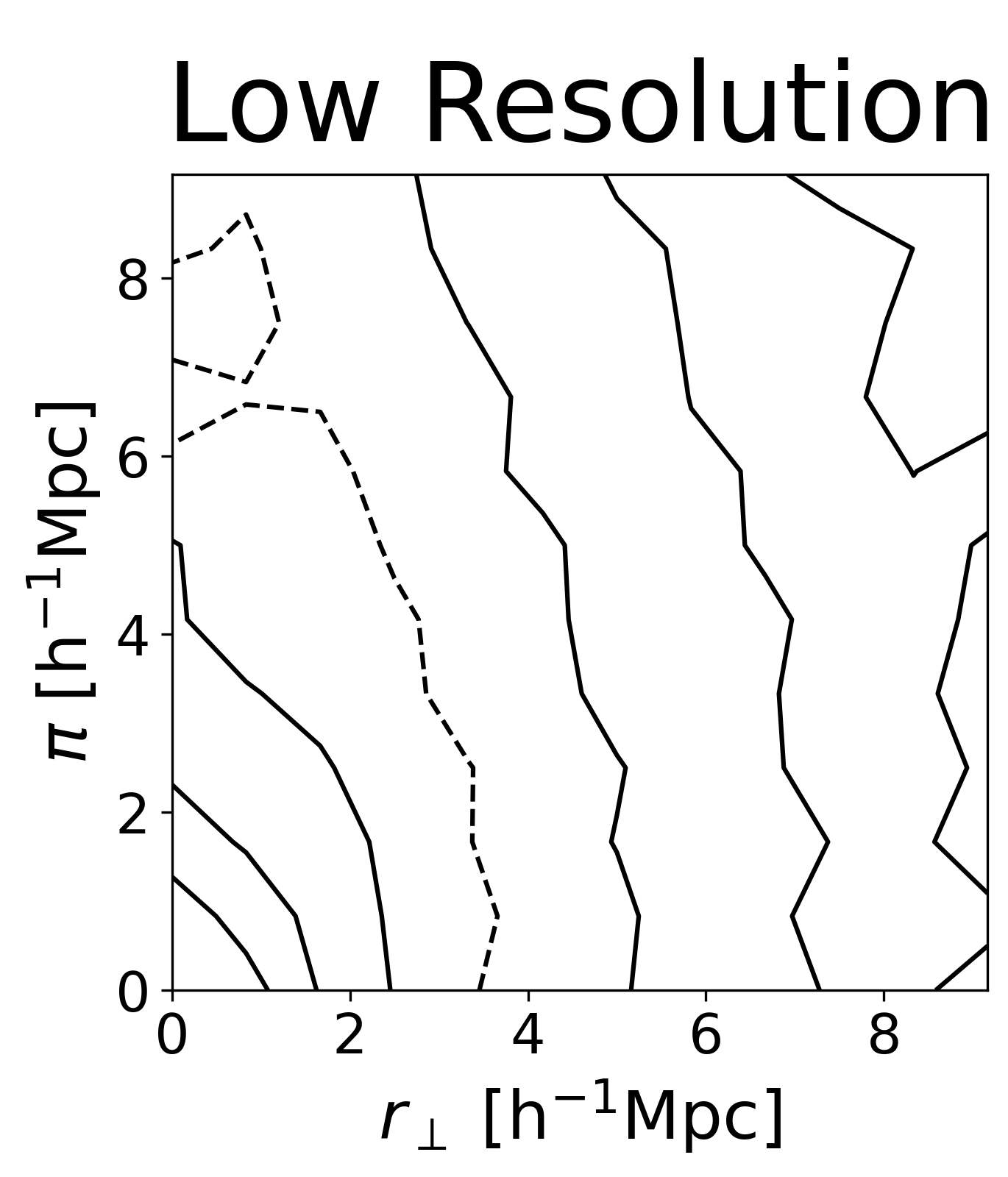
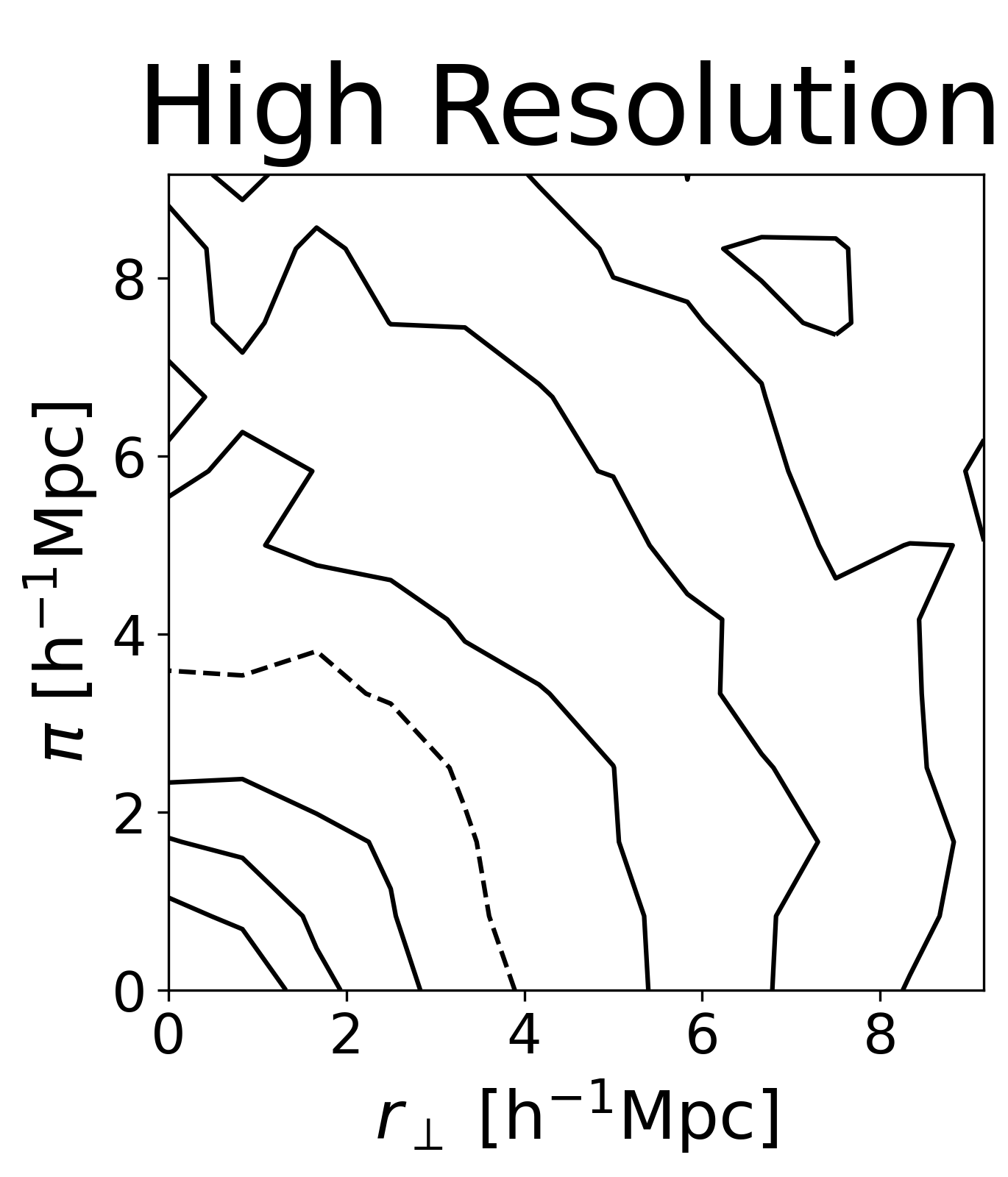 In this paper, we reevaluated
the nature of this effect and find that it is strongly tied to the spectral
shape arising on CGM scales. As the prior publication does not sufficiently
resolve this scale, our result vastly changes as we increase the resolution by
two orders of magnitude based on the Illustris simulations. The distortion
(selection) effect from radiative transfer disappears as we increase the
resolution. A representative plot of this result can be found above.
In this paper, we reevaluated
the nature of this effect and find that it is strongly tied to the spectral
shape arising on CGM scales. As the prior publication does not sufficiently
resolve this scale, our result vastly changes as we increase the resolution by
two orders of magnitude based on the Illustris simulations. The distortion
(selection) effect from radiative transfer disappears as we increase the
resolution. A representative plot of this result can be found above.
While we demonstrated in this paper that there is no radiative transfer distortion effect in our simulations, this does not exclude the possible existence of such effect in reality: The effect strongly depends on the spectrum on leaving the CGM. Dust and clumpiness might strongly effect this spectrum and thus the strength of a possible distortion effect. Future improvements in understanding in the multi-scale modeling (ISM/CGM/IGM) of Lyman- emitter observations will help settling this question.