Radiative Transfer on Voronoi Meshes
An increasing amount of astrophysical and cosmological simulations are carried out on a moving unstructured mesh defined by the Voronoi tessellation.
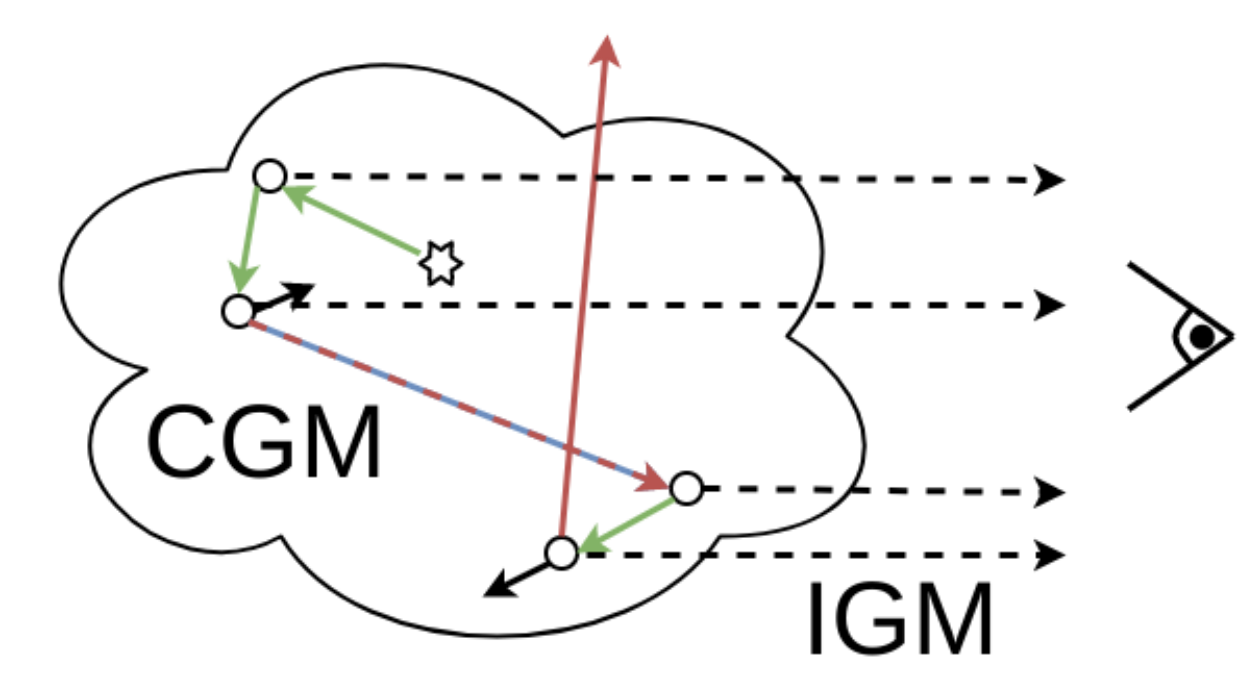
Photons are spawned in a Monte Carlo fashion from emitting gas cells. At each scattering the contribution reaching the observer along specified lines of sight is computed.
We expanded the priorly used code in Behrens et al., 2019 to work on such meshless structure. This ensures the code’s relevance in the future and application to new simulations.
Voronoi Geometry
Below are impressions of the implemented Voronoi geometry:
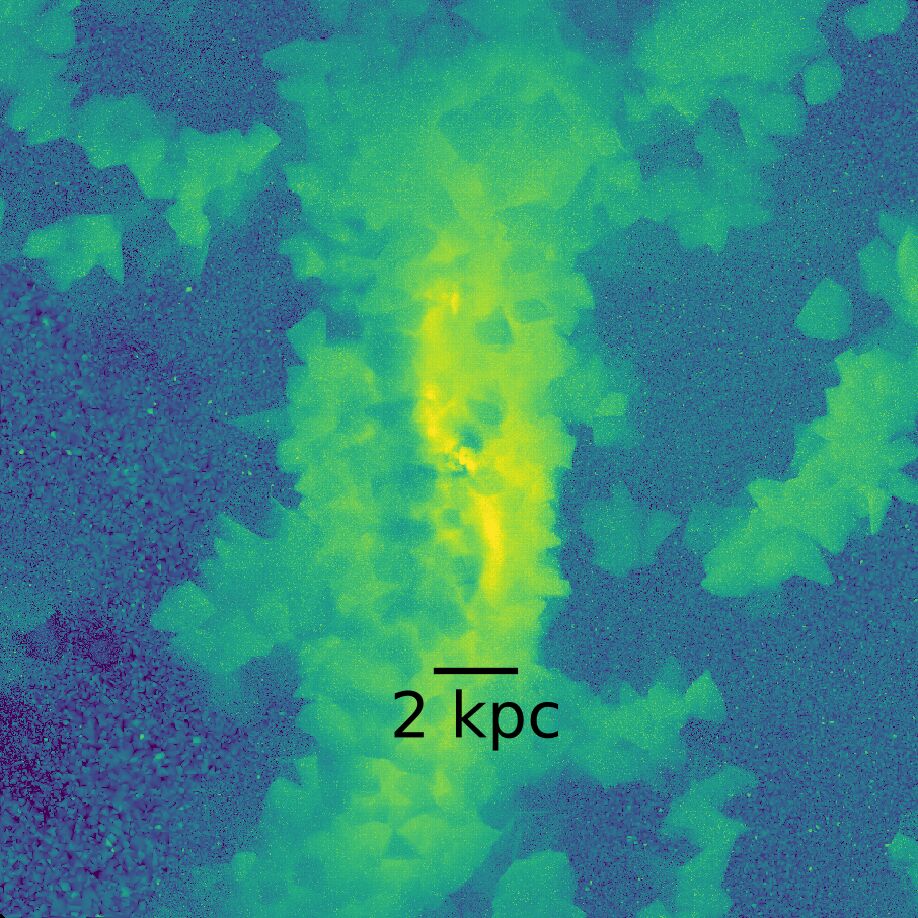
Zoom of edge-on view onto galaxy in IllustrisTNG100 at z=3. On shown scales, the Voronoi gas cells have a maximal resolution of 0.3 kpc. Outside of star-forming regions the resolution can be in the order of kpcs. Yellow regions are well traced out by photons, indicating high HI densities, whereas the cell shapes are not traced in blue regions due to lower densities.
Radiative Transfer
Application of the new radiative transfer code on different scales:
Individual Galaxy
Cosmic Web
This early research on Voronoi-based radiative transfer has since evolved into thor, a modern, massively-parallel GPU-accelerated Monte Carlo radiative transfer code.