Impacts of the Large Scale Structure on Detected Lyman Alpha Emitters
How Lyman-alpha radiative transfer changes the observed clustering of high-redshift galaxies in real and redshift space.
In 1967, Partridge and Peebles proposed that young galaxies emitting Lyman-α photons at high redshift could be used as tracers of large-scale structure. These Lyman-α emitters (LAEs) now provide a way to test the cosmological model and study galaxy environments in the distant Universe.
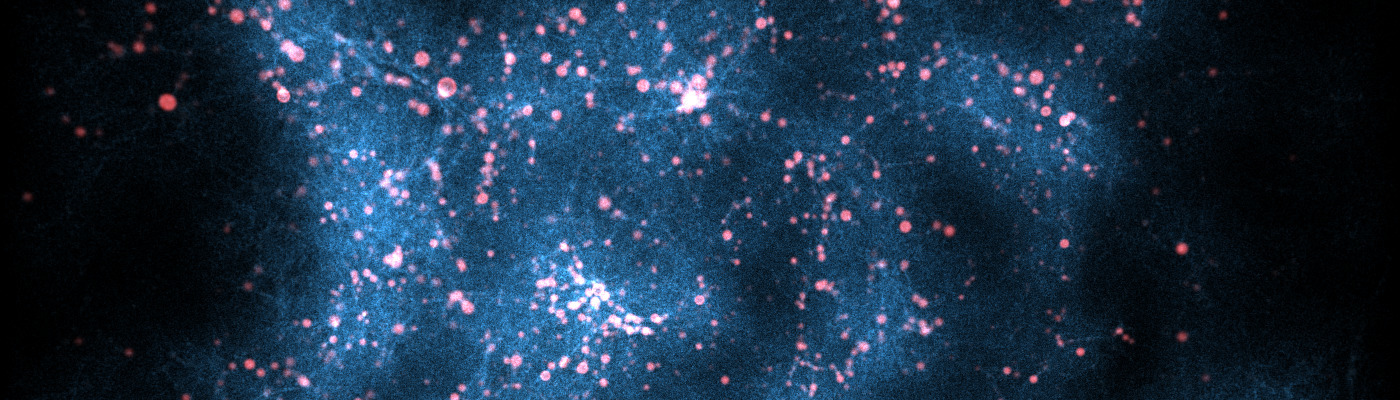
However, the resonant nature of the Lyman-α line and its high optical depth make the connection between galaxies and observed LAEs complex. Radiative transfer shapes their luminosities and spectra, affects which galaxies enter an observed sample, and can therefore alter the inferred relationship between LAEs and large-scale structure. We study these effects through numerical and empirical forward models, ranging from Monte Carlo radiative-transfer calculations applied to the Illustris simulation to survey-calibrated mock LAE populations.
Relevant papers
- The impact of Lyman-α radiative transfer on large-scale clustering in the Illustris simulation (Behrens, Byrohl, Saito & Niemeyer 2018, A&A). We found that the large-scale, anisotropic selection bias induced by radiative transfer is substantially smaller than earlier estimates when the dense gas around galaxies is sufficiently well resolved.
- Radiative Transfer Distortions of Lyman-α Emitters: a New Fingers-of-God Damping in the Clustering in Redshift Space (Byrohl, Saito & Behrens 2019, MNRAS). This follow-up showed that radiative-transfer shifts of the observed Lyman-α peak introduce an additional line-of-sight damping in redshift space and developed a model for this effect.
- Simulating realistic Lyman-α emitting galaxies including the effect of radiative transfer (Khoraminezhad, Saito, Gronke & Byrohl 2025, Open Journal of Astrophysics). This work builds a survey-oriented LAE model that reproduces the observed luminosity function and angular clustering while predicting halo occupation, satellite populations, and the connection between Lyman-α luminosity and halo mass.
For a more accessible overview of the real- and redshift-space radiative-transfer effects explored in the first two papers, see Clustering Distortions from Lyman-alpha Radiative Transfer.