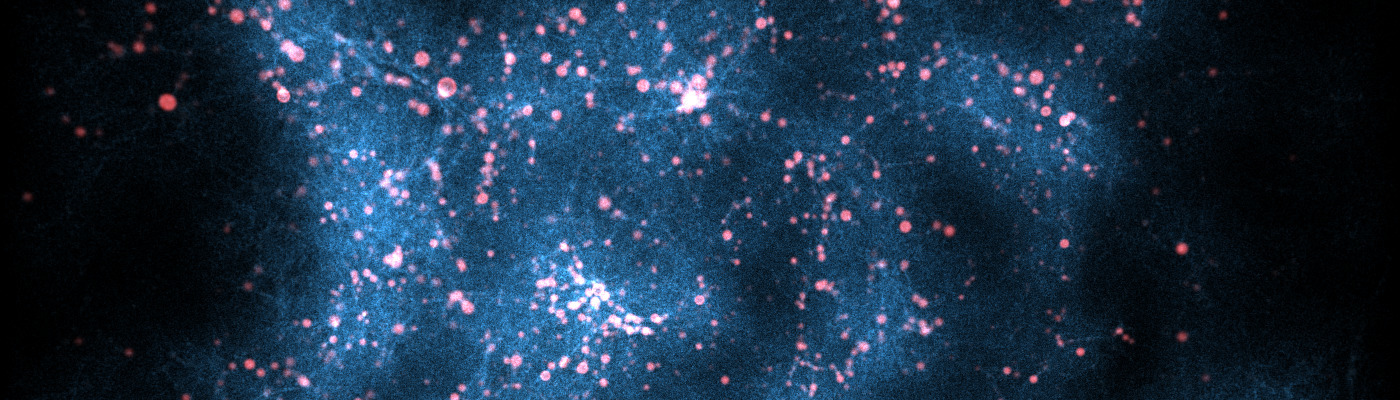
Impacts of the Large Scale Structure on Detected Lyman Alpha Emitters
In 1967 Partridge and Peebles theorized that young galaxies at high redshifts emitting Lyman-α photons might be a suitable tracer of large-scale structure. Those distant galaxies of high Lyman-α emission, so-called Lyman Alpha Emitters (LAEs) can be used to constrain the cosmological standard model at high redshifts and furthermore allow insight for the environment of those galaxies.
The resonant nature of the Lyman-α line and the high optical depths give rise to a complex radiative transfer that can affect large scale inferences from detected LAEs. This can be investigated by means of radiative transfer simulations as Monte Carlo approach on top of the Illustris simulation.
Results for the clustering signal in real space have been published, and a follow-up paper for possible additional effects on the clustering signal in redshift space is available.